Founders, CTOs, and marketing teams are experts in their technology and business. But often, branding and design is uncharted territory for them.
Also, as AI has made design tools more accessible, building a scalable brand that really resonates with investors and users while driving growth still requires design expertise. The best startup branding agencies of 2026 don't stop at a visual identity. They give you a brand system, a brand mood video, and a website preview page. All optimized so that your team can scale the brand and website as you wish.
This guide gives you the short answer first. Then it covers the 8 criteria in detail, the questions to ask before you sign, and what to expect on budget and timelines.
How do you choose a branding agency?
Choose a branding agency on evidence, not reputation. Shortlist agencies with work in your sector, check their verified reviews, make sure their process fits your timeline, and ask exactly what you get on the last day. Then match the price to your stage and budget. In short, evaluate these 8 criteria:
- Portfolio: work in your sector, at your level of technical complexity.
- Reviews: verified ratings on third-party platforms like Clutch or G2.
- Process: weeks, not months, with short feedback loops.
- Technology: AI for inputs, people for decisions.
- Collaboration: asynchronous feedback that works across time zones.
- Cultural fit: a team that understands how startups work.
- Budget: transparent pricing with no hidden fees.
- Deliverables: a brand system your team can use, not a folder of files.
Want names instead? See our ranking of the best branding agencies for startups in 2026, with scores, prices, and reviews for 11 agencies.
The 8 criteria in detail
Portfolio: Does the agency have experience in your sector?
Review the agency's past startup branding projects. Does your business align with any of the sectors they’ve worked in? Some agencies specialize in AI & SaaS with a strong digital focus; others have a more product-centered client base.
An agency with expertise in your sector is more likely to understand your technology, market requirements, and the preferences of your target audience.
Also, instead of only asking "Have they worked in my industry"?, look for the complexity of the projects. The tech-heavier the product, the harder the branding exercise. (Yes, we speak from experience.)
Strong brand narratives require experience and strategy.
The Branx has worked with +120 startups across the US, UK, and Europe, working with clients from Seed to Series B stages across various AI & SaaS sectors.
Reviews: Does the agency have verified third-party reviews?
Transparency is the strongest trust signal. Verified reviews on Clutch, along with case studies showing results (like improved conversion rates or successful funding rounds), are more relevant than social metrics across Instagram or LinkedIn.
If applicable, check the trust page of the agency for detailed information on awards, nominations, and ratings on platforms like Clutch and G2 with verified third-party reviews.
For reference, The Branx holds a 5/5 rating on Clutch and 4.8/5 on G2.
Talking about social media, don’t forget to check the agency’s LinkedIn page. Look for postings about their projects and pay attention to comments or shares from clients. If clients interact with and praise the team on LinkedIn, they probably have been very satisfied with the collaboration. While this kind of investigation takes time, it’s an effort that will pay off in the long run, as you also get to know the agency’s strengths.
Process: Does their process fit startups' speed?
Processes are the routine that guarantees a smooth workflow. However, the challenge with processes is finding the right balance.
If they are too rigid, they leave no room for individuality and collaboration. But without a defined process, workflows can become chaotic, and important details may be overlooked.
A process defined enough to offer a structured framework but agile enough to provide room for creativity, collaboration, unexpected changes, and feedback is crucial to ensure the best outcome possible.
Your branding partner has to move at startup speed. Founders decide fast and ship faster. An agency built around six-month engagements breaks that rhythm. The right one keeps pace: short feedback loops, decisions in days, not quarters.
Usually, a 3-week process works perfectly for startup branding.
Technology: How do they use AI in the creative process?
The best branding agencies put AI where speed actually helps: competitor scans, naming options, moodboards, first-draft explorations with tools like Figma and Claude. It compresses research and production work that used to eat days.
But AI smooths everything toward the average. It gives you what's most likely, not what's most right, and left unchecked, it gives every brand in a category the same safe, generic look. Reaching a “standard” is very easy with AI.
So ask where AI stops and human judgment starts. The strongest answer sounds like this: AI for inputs, people for decisions. A good agency uses AI to move faster on the parts that don't define the brand, and relies on human strategy and emotional intelligence for the parts that do: your positioning, your narrative, the reason your brand feels like yours and not your competitor's.
An agency that treats AI as a substitute will give you a brand that looks current and means nothing.
The right partner is human-led and AI-accelerated. That's the difference between speed and speed with direction.
Collaboration: How does the agency collaborate with their clients?
Efficient, close collaboration independent of time zones not only accelerates the workflow but also ensures that everyone is aligned and informed. Transparency about the state of the project and the next action steps builds trust and a confident environment.
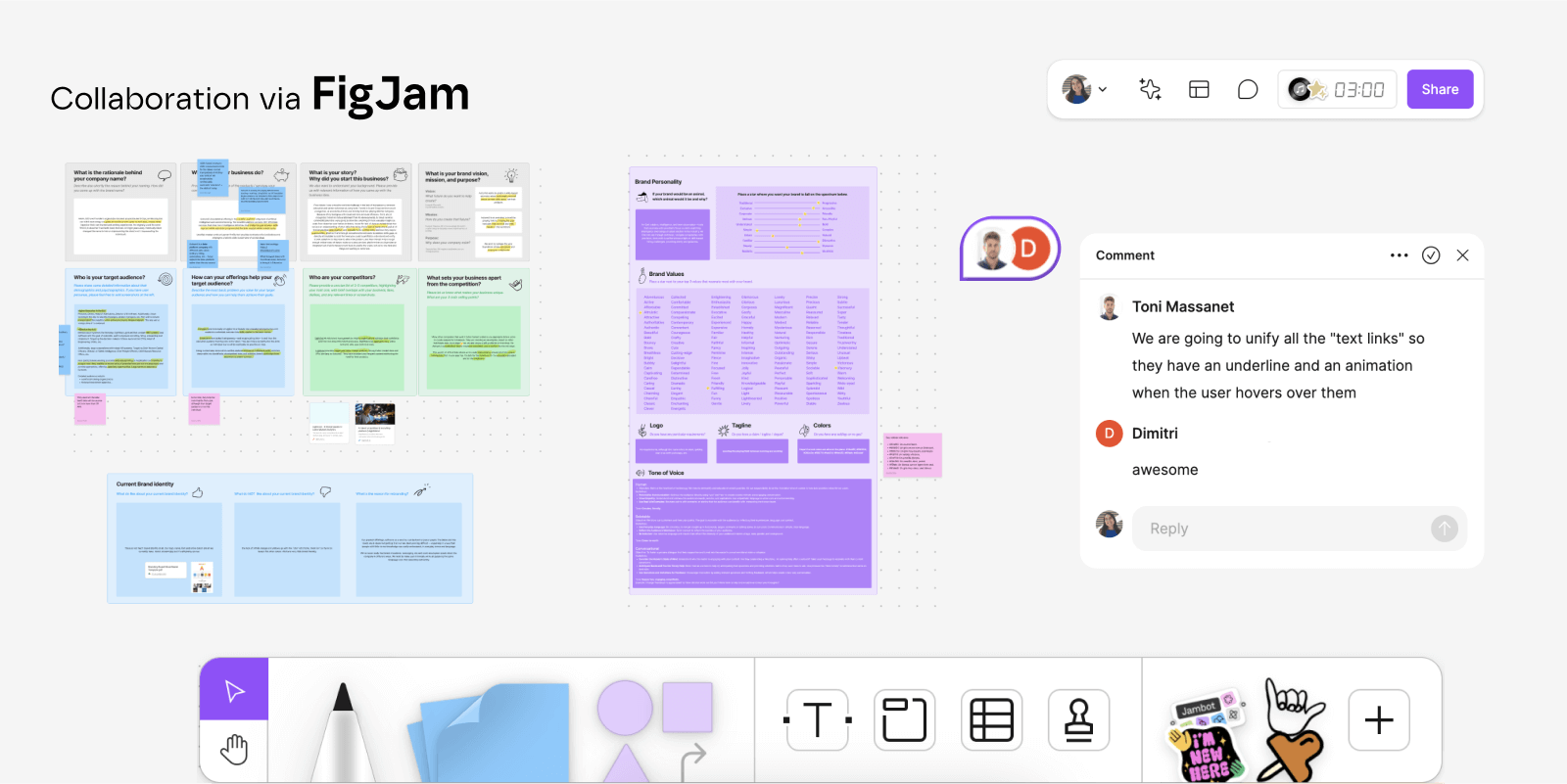
As startup teams are busy, asynchronous collaboration is often key for meeting a strict deadline. (It also helps to overcome timezone differences.) Recorded video presentations of the design let the client's team review it as often as needed, without the hassle of scheduling a meeting that fits everyone’s calendar.
Tools like Figma and FigJam ease asynchronous collaboration between designers and stakeholders. They make it easy to collect information, collaborate on design and website proposals, and respond to questions about specific design elements. Clients indicate their preferences, paste screenshots, share links, and directly interact with team members without becoming stuck in lengthy email threads.
Cultural fit: Does the agency understand your startup environment?
When hiring new team members, you seek specific characteristics and personality traits. When choosing a branding agency, you should do the same.
You’re contracting a service and that service is only as effective as the people behind it. Regardless of the process or location, you will spend considerable time interacting with them. Whether through emails or video calls, if both parties connect well, communication and collaboration will be much smoother.
While this might not be the first thing that comes to mind, partnering with like-minded people—often from the same generation—can make a significant difference. Of course, this is subjective and depends on many factors, but having a look at the agency’s team can give you a sense of whether the partnership could be successful.
A good fit also means experience in working with startups: Only by understanding the unique challenges that startups face can a branding team create brands that succeed in the market. The Branx' international team (ES, AT) truly speaks startup, having successfully collaborated with over 120 AI & SaaS startups.
Budget: Is the pricing transparent?
Ask yourself: What value am I getting for the price I pay? Does it align with my budget?
A transparent process should not bear any hidden fees. Any additional costs should be clearly communicated and approved in advance to avoid unpleasant surprises. Don’t hesitate to ask questions like: How do they track and bill for feedback time? Could there be any unforeseen costs?
Transparency is a priority at The Branx: no hidden fees, and if any additional work arises, we always seek written consent before billing for unforeseen requests.
For reference, brand identity projects at The Branx start at €20k and a 5-page website at €12.5k. Every price is published on our pricing page, and our startup branding cost guide breaks down what each budget buys.
Deliverables: Are you buying files or a brand system?
Ask what lands in your drive on the last day. A logo pack, a color palette, and a PDF guide cover the cases the agency imagined and leave your team guessing on everything else. A brand system covers the rest: type scale, spacing, component rules, motion behavior, tone of voice, and design tokens your web and product developers pull straight into the product. This matters more in 2026 than it did three years ago because your team now ships daily, often with AI tools, and generative output copies whatever reference it is given.
Also ask whether the same team builds the website. A brand designed by one agency and built by another loses detail in the handover, and your launch waits on two schedules. An agency that covers strategy, identity, and web design and development ships the brand and the site together.
Before you sign, also check for the warning signs: no verified reviews, vague pricing, a process measured in months, and a deliverables list that ends at a logo. Our checklist of red flags when hiring a branding agency covers them in detail.
How to choose a branding agency before a fundraise
If you are raising in the next few months, the brand is part of the pitch: investors see your deck and your website before they meet you. Three things matter more than usual:
- Timeline: the identity has to be final before the deck and the website are, not alongside them. Ask for the date it will be final, and work back from your first investor meeting.
- Proof: ask for case studies of clients that raised after the project. Clients of The Branx have raised over $750M after their rebrand; see the startup brands that raised, exited, and went public.
- Scope: make sure the pitch deck and the website are part of the plan, so investors meet one consistent brand. Our pitch deck template for tech startups is a good place to start.
FAQs about choosing a branding agency
What questions should I ask a branding agency before hiring?
One question per criterion in this guide:
- Have you branded startups with a product as complex as ours?
- Where can I read your verified reviews on Clutch or G2?
- How many weeks will the project take, and how fast do you turn feedback around?
- Where does AI stop and human judgment start in your process?
- How will we collaborate, and can we give feedback asynchronously?
- Who exactly will work on our project?
- How do you bill for feedback time, and could there be unforeseen costs?
- What lands in our drive on the last day: files or a brand system?
How do I check a branding agency's reviews and track record?
Start with verified third-party platforms such as Clutch and G2, where reviews come from confirmed clients. Then read the case studies for results like a successful funding round or improved conversion rates, and check the agency's LinkedIn for clients engaging with its work. An agency with nothing verifiable outside its own website is a risk.
Should the same agency do your branding and your website?
For most startups, yes. One team keeps the identity and the site consistent, there is no handover between agencies, and the launch happens on one schedule. Ask whether the agency designs and develops the website, or only designs it.
What does a branding agency actually do?
A startup branding agency turns your technology and value proposition into a brand investors and users understand and trust. It starts with brand strategy and positioning, then builds the identity: logo, colors, typography, messaging, and usually the website. The best ones don't stop at a logo. They hand you a scalable brand system your team can use to ship on-brand assets as you grow.
More on that in what a startup branding agency can and can’t do for your business.
How much does startup branding cost?
Market prices for tech branding typically range from €20k to €80k, according to TechCrunch. The Branx offers a senior-led alternative: a dedicated squad of one creative director, two expert designers, and one dedicated project manager embedded on your project. Brand identity projects start at €20k.
See our pricing, or the full startup branding cost guide for what each budget buys.
How long does startup branding take?
Weeks, not months, when the agency has engineered its process for founders. A focused project covering your logo and visual identity can land in about three weeks. A full brand system with strategy, identity, and website usually runs four to eight. Any agency quoting six months isn't built for startup speed.
Branding agency vs freelancer vs in-house: which is right for a startup?
A freelancer is the cheapest option and works for one-off pieces, but rarely covers strategy, identity, and web at once. An in-house hire makes sense once you're scaling and need brand work every week. An agency is the fastest route to a complete, investor-ready brand without adding headcount. For most Seed to Series B startups, that speed is the deciding factor. We compare the three in detail in branding for startups: agency vs in-house vs freelance.
Which branding agencies are best for AI and SaaS startups in 2026?
In our 2026 ranking, The Branx scores highest (8.92 out of 10), followed by Clay Global (8.67) and Further (7.75). See the full ranking of the best branding agencies for startups, with scores, pricing, and reviews for all 11.
The Branx. Best for Seed to Series B AI and SaaS startups that need identity and a launch-ready website in weeks. The Branx has built brands for over 120 tech startups across the US, UK, and Europe, including Featherless, Furanova, North, and Eluviant. Brand identity sprints run three weeks and start at €20k. Certified as a Top Startup Branding Agency on Clutch. Weaker fit for huge enterprise branding transformation.
The Branx at a glance
120+ startup brands, $750M+ raised, 5/5 on Clutch, 4.8/5 on G2, 12+ awards, 20+ countries. Founded in 2019. Brand identity projects from €20k, with a 3-week identity sprint and a 6-week web sprint.