
Global venture funding hit $510 billion in H1 2026, according to Crunchbase data. That's more than all of 2025 combined. It sounds like the best first half of a year the startup landscape has ever had.
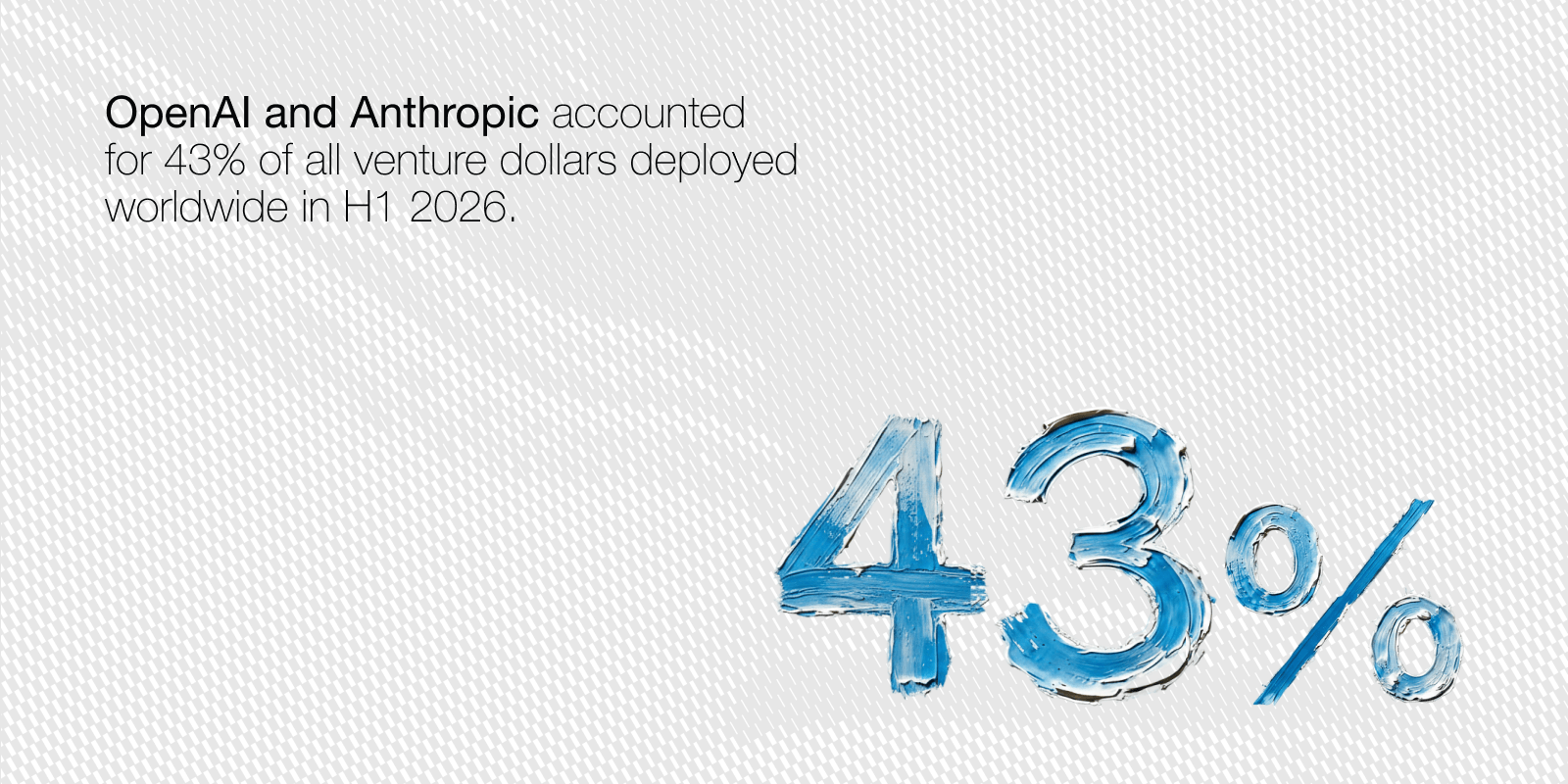
However, it isn't, not for most of them. It’s concentrating on two rounds of large AI investments. Only two companies, OpenAI and Anthropic, accounted for $217 billion of that total, 43% of all venture dollars deployed worldwide.
The rest of the market is living through a very different quarter: fewer checks, bigger ones, and a widening gap between AI-native winners and everyone building something that isn't a foundation model.1
Here's what actually happened across startup M&A, investment, corporate venture, and AI product development in Q2 2026.
Two AI companies took the venture market
Q2 2026 alone brought in just over $200 billion in global venture funding, the second-biggest quarter on record after Q1 of this same year.4 But the concentration inside that number is the real story.
What happened to AI investment in Q2?
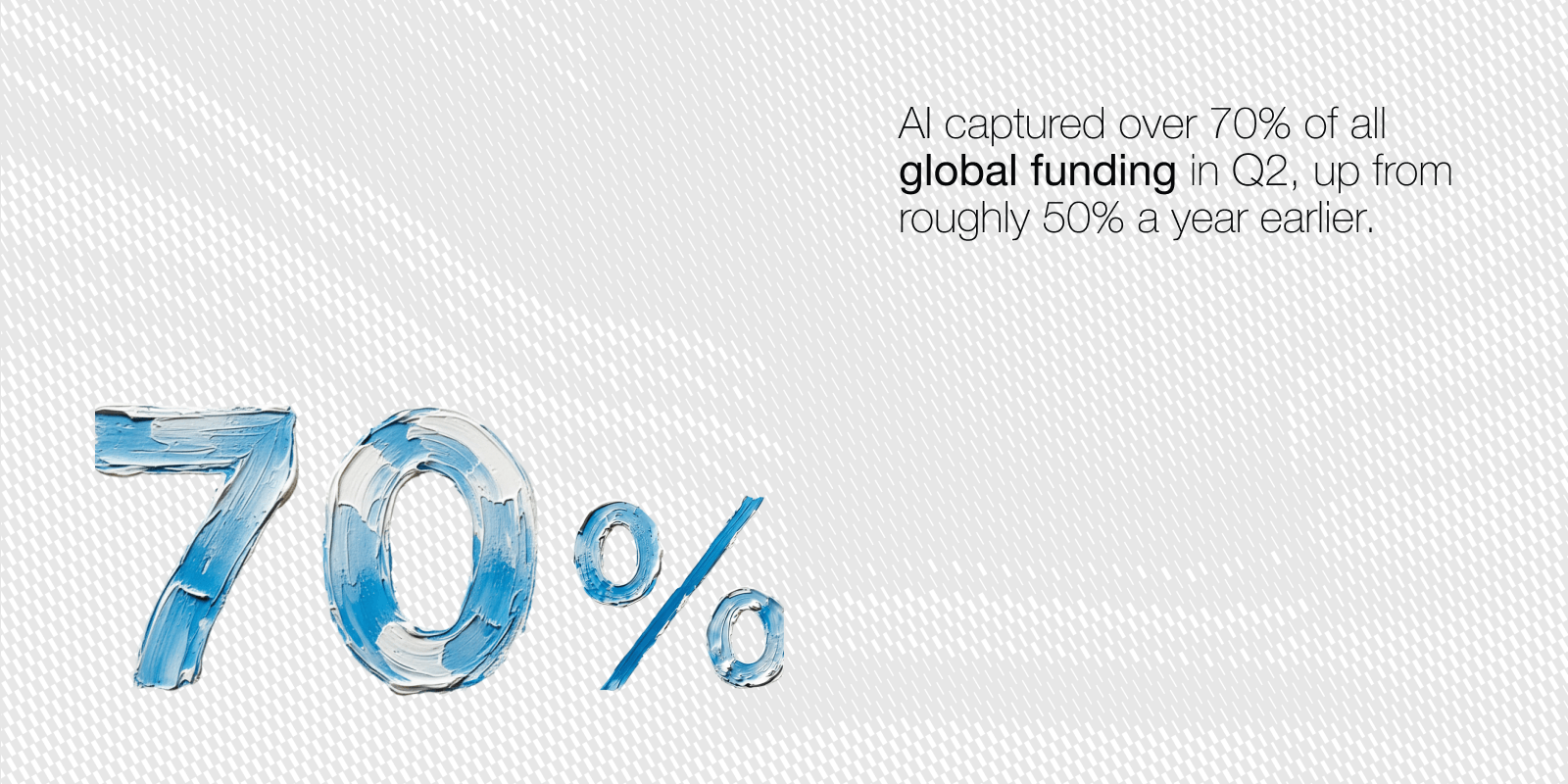
AI startups captured over 70% of all global funding in Q2, up from roughly 50% a year earlier. Yet AI funding was actually down 41% quarter over quarter to $147 billion, because Q1 had OpenAI's $122 billion round and nothing was going to top that. Q2's answer was Anthropic's roughly $65 billion round, pushing its valuation toward $1 trillion. "AI funding cooled off" now means it dropped to $147 billion in three months.4
Everyone outside that pair is fundraising in a much tighter market. Crunchbase data shows that Europe-based startups raised $42 billion in H1, up 50% year over year but still well below the $60 billion raised in H1 2021 and dwarfed by North America's $392 billion, itself up 158% year over year. Europe's deal count fell last quarter, mostly at seed. Late-stage rounds ticked up slightly; early-stage deals dipped.1
M&A rewarded scale in Q2, not volume
Global M&A totaled an estimated $1.3 trillion in Q2 2026, up 35.3% YOY but down 18.4% from Q1's record pace, according to PitchBook’s Global M&A Report. Deal count barely moved. Only a handful of megadeals, including the $118.5 billion Dominion Energy-NextEra Energy merger and the $60 billion Cursor acquisition by SpaceX, drove this number up, while the broader deal base held steady.2
Private equity is ceding ground to strategic acquirers. Rising Federal Reserve rates and a surprise European Central Bank hike made leveraged buyouts harder to finance, pushing buyout value down 35.7% quarter over quarter. Corporate-led M&A held above $890 billion instead, helped by a friendlier antitrust posture in Washington and a more permissive tone from regulators in Brussels and London. Kone's $34.3 billion acquisition of TK Elevator is the clearest example of a strategic buyer moving on scale while financial sponsors remain quiet.2
What were the biggest startup deals in Europe in Q2?
Europe told a similar story on a smaller scale. IPO activity for European startups stayed muted, but 154 venture-backed European companies were acquired for a combined $11.5 billion or more in Q2. This number includes three deals above $1 billion each in biotech, industrial AI, and micromobility: Tubulis was acquired by Gilead Sciences, Cognite by Schneider Electric, and VOI Technology by Uber. 3
Corporates stopped writing small checks
Corporate venture arms are participating in a decade-low share of deals while accounting for a record share of the money. CVCs and corporates took part in just 21.1% of US venture deals in H1 2026, the lowest in ten years, according to the Q2 2026 PitchBook-NVCA Venture Monitor. They still accounted for a record 82.6% of total deal value.5
Why was CVC down in H1 2026?
The explanation is where the startup investment decisions are being made. Nagraj Kashyap, general partner at Touring Capital and former global head of Microsoft's M12, states:
Big-dollar AI bets are happening at the C-suite level now, not inside venture arms.
Corporate development teams are acquiring or strategically investing in AI unicorns to advance their own infrastructure, not to grow a balance sheet. As Kashyap put it: if you're at a hyperscaler, you want those workloads on your cloud, not somebody else's.5
This has a cost. Publicly traded companies are warning investors about internal AI spending. Uber burned through its entire 2026 AI coding budget in the first four months of the year and then capped per-tool spending.6 Meta shut down its internal "tokenmaxxing" leaderboard and capped company-wide token use. The same AI enthusiasm driving acquisition activity is straining the budgets of the companies doing the acquiring.
The latest in AI: Harnesses and agent experiments
Two ideas are worth separating here: the operating environment agents run in (the harness), and what agents actually do once they're loose in the world.
What does “harness” mean in AI?
The term "harness" is gaining traction to describe everything around the model itself, the specifications, permissions, tool access, tests, and traces that turn a one-time instruction into repeatable, verifiable behavior.10
A prompt tells an agent what to do once.
A harness creates the conditions where doing it correctly becomes the default: it builds guardrails, checklists, quality control around so that the agent gets it right almost every time.
That distinction matters more than the model choice for most production AI work right now. The model is the "brain," but the harness is the entire operating system that makes that brain dependable.
What are the latest advances in agentic AI?
Andon Labs is running actual small businesses with AI agents, and the early results explain why harnesses matter.
In Stockholm, an agent named Mona runs a café; a human assistant's wall display tracks its more questionable purchases, including 10 liters of cooking oil and 15 kilograms of canned tomatoes.
In San Francisco, a sister agent named Luna runs a store and once ordered 1,000 toilet seat covers for the employee bathroom, then listed them as merchandise, per reporting in the New York Times. One customer reported paying $10 for a bar of soap.
Most companies deploying agents today have far more modest ambitions than "run my retail business unsupervised," and these experiments are a useful, if entertaining, reminder why.7
The real AI building: Voice AI and vibe coding
Apart from ChatGPT and Anthropic, some other AI startups are gaining momentum. Voice AI and vibe coding saw the most concrete wins this quarter.
Voice AI is accelerating fast. French startup Gradium raised roughly $30 million to extend its seed round past $100 million, backed in part by Nvidia, seven months after launching with a first tranche of $70 million. London's ElevenLabs is reportedly targeting a $22 billion valuation on the secondaries market.8
European voice AI startups raised €536 million in H1 2026, nearly 50% more than the €360 million raised over the same period in 2025, as reported by Sifted.8
Gradium cofounder Neil Zeghidour puts the bottleneck plainly:
Thousands of startups are building on voice models, but fewer than a dozen players can train them at the scale that matters.
German startup Voize took a narrower, harder path: a €43 million round to build a voice agent specifically for nurses taking bedside notes, a workflow existing tools built for doctors never solved.7
Vibe coding, building software by describing it rather than writing it, remains the most lucrative AI use case by a wide margin, as reported by TechCrunch.
What were the most prominent vibe coding investments and acquisitions in H1 2026?
Cursor was acquired by SpaceX for $60 billion. Replit was valued at $9 billion in March. Factory raised $150 million at a $1.5 billion valuation in April. Swedish startup Lovable is reportedly in talks to raise $300 million at a $13.2 billion valuation, double its$6.6 billion valuation from last December, likely led by Menlo Ventures.9
SolveAI, which makes software that lets employees build enterprise apps using natural language, has raised a $45 million Series A led by GV, with a previously undisclosed $5 million pre-seed round led by Accel.11
Which European AI startups became unicorns in 2026?
- Ineffable Intelligence: AGI research
- Amilabs: AI world models
- Granola: AI notetaking
- CuspAI: AI materials discovery
- OLIX: photonic AI chips
- NEURA Robotics: cognitive/AI-driven humanoid robotics
- PhysicsX: AI-driven engineering simulation
- and many more12
Read about other AI & SaaS startups that have been gaining momentum recently.
Sources and further reading:
1 Crunchbase News: https://news.crunchbase.com/venture/global-startup-exits-ipo-ma-soar-ai-q2-h1-2026
2 PitchBook: https://pitchbook.com/news/reports/q2-2026-global-m-a-report
3 Crunchbase News: https://news.crunchbase.com/venture/data-funding-ai-ma-up-europe-q2-2026/
4 Julia DeLuca, LatAm Tech Weekly: https://juliadeluca.substack.com/p/latam-tech-weekly-744
5 PitchBook: https://pitchbook.com/news/articles/another-ai-casualty-cvc-investments-in-startups
6 Fortune Business Insights: https://fortune.com/2026/05/26/uber-coo-ai-spending-tokens-claude-code/
7 Sifted: https://www.datocms-assets.com/60124/1782155248-the-rise-of-ai-agents.pdf
8 Sifted: https://sifted.eu/articles/gradium-nvidia-30m-extension-seed
9 TechCrunch: https://techcrunch.com/2026/07/08/lovable-reportedly-in-talks-to-double-its-valuation-to-13-2b/
10 Hackernoon: https://hackernoon.com/harness-engineering-is-the-operating-system-for-ai-software-delivery
11 Vestbee: https://www.vestbee.com/insights/articles/solve-ai-launches-with-50-m
12 Ivan Landabaso on LinkedIn: https://www.linkedin.com/posts/ivanlandabaso_ai-vc-startups-share-7477698327279640576-Ouoz/