“Brand is one thing that is very hard for an AI to copy, and that reputation, that trust that comes with it, is also very important.”
Aviator is a San Francisco-based AI developer workflow automation tool. It lets large engineering teams ship AI-generated code safely and fast.
Back in 2022, we created their brand identity around the airplane logo and the bold yellow lead color. Its core is still live. We’ve talked to their CEO Ankit Jain about the importance of branding in times when AI lowers the cost of building, which raises the value of everything AI can’t clone: brand, trust, reputation.
"There are now hundreds of companies being created every day... we definitely have a lot of companies who copy our ideas and build software. This is where brand really matters."
The impact of a startup’s branding in 2026
In 2026, startups are facing a differentiation problem. Because AI has collapsed the barrier to building software (anyone can spin up a competing tool quickly), the product itself stops being a reliable moat. Copying ideas and shipping fast versions of them has become easy.
When the software is easy to replicate, trust and recognition are what’s hard to copy.
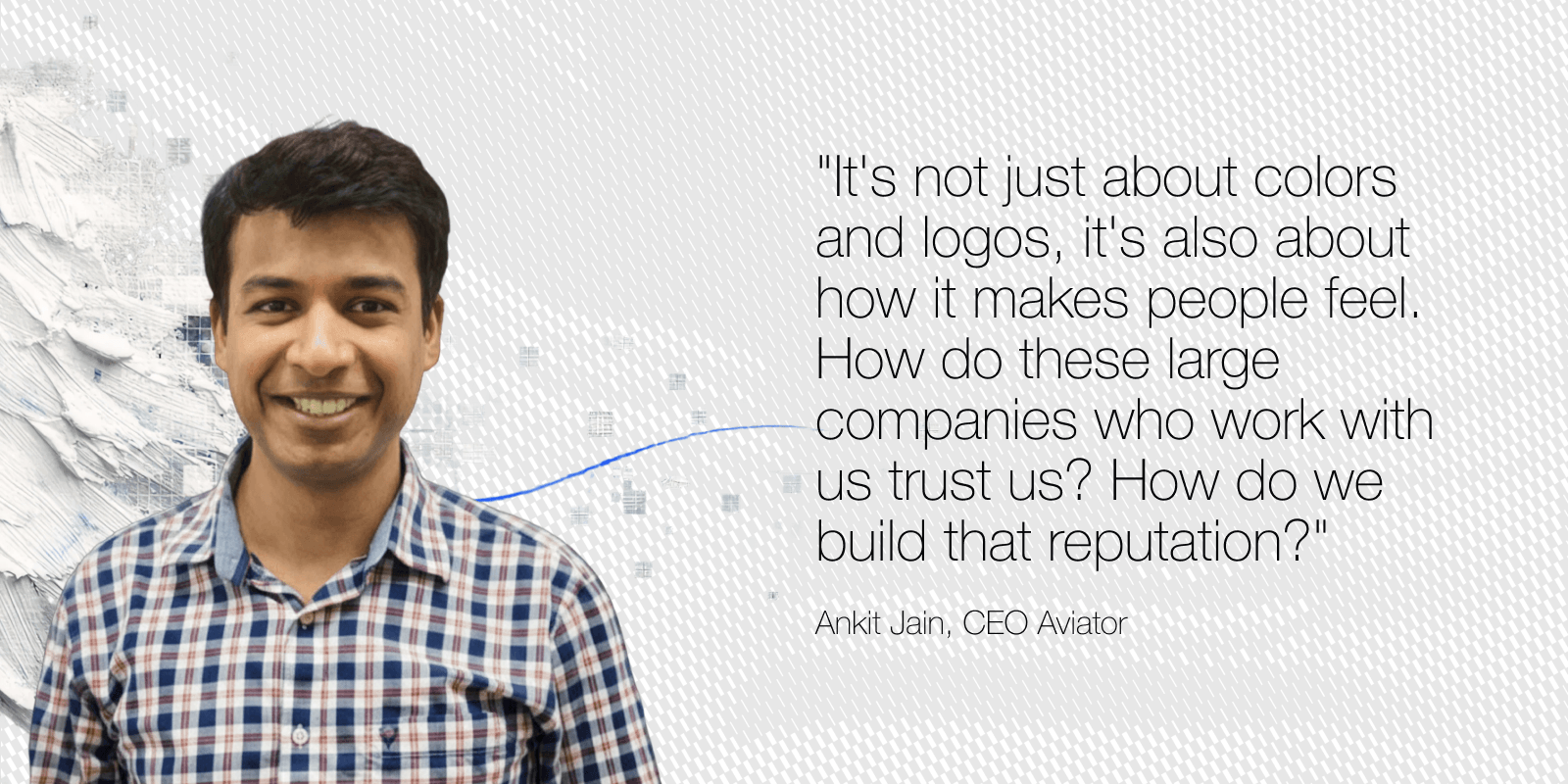
In this interview, Ankit explains why brand became his hardest-to-copy asset once AI made building competing software trivial.
Complete interview transcript
Ines: Good to see you again, Ankit. It's impressive what you've achieved with Aviator, still out there, still optimizing workflows. When we worked together, back in 2022, you were all about "merge queues" and fixing broken builds. I've had a look at your website now, and there's this AI-forward slogan around optimizing workflows with AI. In your words, what's changed in your value proposition, and what's stayed the same?
Ankit: A lot of it is still the same, actually. It's something we talk about a lot in our developer communities too: the more AI adoption happens across software engineering, the more the fundamentals stay the same. Some of the same development best practices that were popular 10 or 20 years ago are still relevant. In fact, they're more relevant today. That's part of why we've grown well. We work with brands largely because everyone feels the same pain: everything is broken all the time, and we provide better tools for developers to manage that chaos.
Ines: That's great. You're working with Slack, Figma, other giants you've partnered with. With so many possibilities, how do you plan your roadmap? How do you prioritize what to build next, or what to fix next?
Ankit: The roadmap changes every two months, honestly. The AI industry moves so fast that it's really about how quickly we can get signals from our audience and our customers. We run a community called Hangar DX, which has become a big part of our brand. It actually uses one of the logos you all built, the little plane logo. We do regular sessions with a custom advisory board made up of leaders from that community, to understand what the problems are and where things are heading, and then we try to align our roadmap with that. That's how we stay in the loop and try to solve real problems for our customers.
Ines: Love it. You mentioned your own podcast, Hangar DX. Talking to engineers, do you see any particular trends or challenges they're facing because of AI adoption?
Ankit: Definitely. This is actually close to one of our product's core taglines: AI has made it pretty easy for anyone to write code, but it's genuinely hard to ship that code today. Building code as a single developer has become very easy, you can use one of the vibe-coding tools, but enterprise software is different. You need to maintain legacy systems that have been around for 10 or 15 years, and make sure everyone can collaborate and understand how the system works. The problems are different, and that pattern shows up everywhere. Another interesting pattern: even with all the noise in the industry, nobody has perfect answers. Even we don't know where things will be in two years, or maybe even one year. So it's about finding signals for the next step, building toward that, then taking the next step. We really only have a clear window into the next three months. The rest, we're still figuring out.
Ines: Your tagline is essentially "AI made code easier to write, not easier to ship." What do you do to maintain quality in your own product, given that?
Ankit: We build a lot of guardrails. Everyone at the company has access to agent tools, but whenever someone submits code, we run it through verification capabilities that create evidence we can review and validate. In a world where most code is going to be written by machines, we need much better guardrails, and that's something we constantly work on and improve. That's how we build better software.
Ines: I wouldn't be doing my job at a branding agency if I didn't ask about branding. I'm glad to see the logo is still out there, the airplane, and the yellow. I know some things have changed. What's your take on how important branding was to your success?
Ankit: Even starting from the name itself, Aviator gives us the framing of a platform that helps people automate their workflows, almost like being a pilot for them. On the color and brand side, yellow is a color that's not used much, which has helped us stand out. We use your logos even for Hangar DX. That community wasn't really a thing when we worked together back in 2022; we started it in 2023, and now people recognize it well. We even print the plane logo on shorts and give them to people, their kids love it. It's a very well-received mark. As the company has grown, this is how people recognize us, so it matters that we maintain that consistency. That's how you build a brand.
Ines: Yellow is a bold choice, especially in the dev-tools space, where everything tends to be dark mode with the typical blues. I imagine that sparks something for you as a branding person too. I also think the community-building work you've done with Hangar DX is impressive. In your words, especially now that AI is making brands feel more generic, do you think the importance of branding is changing?
Ankit: There are hundreds of companies being created every day now. The barrier to building software has dropped a lot, which means we see a lot of companies copying our ideas and building similar software. That's exactly where brand really matters. It's not just about colors and logos, it's about how it makes people feel. How do large companies that work with us come to trust us? How do we build that reputation? It's the same reason people pay a premium for an iPhone but wouldn't buy a cheap phone with the same features. Brand is one of the few things that's genuinely hard for AI to copy, and the trust and reputation that come with it matter a lot. That's why it's so critical today.
Ines: Love it, and I share that opinion. I want to be respectful of your time. Your path has been impressive. What's the single best piece of advice you'd give other founders? Or is it simply "survive the rollercoaster"?
Ankit: I don't know if I have advice broad enough to be new. Most of what's already been said over the last 10 to 20 years is still relevant: you need to talk to your customers. One thing that matters more in our field, maybe, is that software engineering is changing so fast that even after years in the business, you have to constantly look for what's coming next. In some ways it's the "stay hungry, stay foolish" idea: you have to stay hungry to find what's next and stay on top of it. The formula is still the same, though. Talk to your customers, keep bringing that back into the product, and keep iterating on the idea.
Ines: Perfect, I'll stop the recording here. Thank you so much, I'll follow up with a few more questions offline. Thanks for your thoughts.