Even now, people email me asking, "Do you have any more Screenloop socks?"
Screenloop is a London-based HR tech startup that redefines what an ATS (Applicant Tracking System) can do. The all-in-one Talent Ops Platform enables teams to make smarter, faster hiring decisions.
In January 2026, Screenloop was acquired by Equitas, a leading IaaS (Interview-as-a-Service) platform that works with some of the largest organisations across the UK and Ireland. This acquisition brings together two businesses that share the same belief: better interviews lead to better, fairer hiring decisions.
What's the secret behind the successful startup brand?
When we received the Screenloop branding briefing back in 2021, all we got was half of a Google document with rough instructions. No one was anticipating yet that the startup would get acquired by one of the biggest video interview platforms. We created their visual identity, including a hand-crafted illustration system that puts the humans (the interviewer and the interviewee) first.
Now, four years and an acquisition later, the core of the HR tech startup's brand identity is still the same, and their team has scaled it across digital platforms and merch material.
We spoke to their GTM lead, Akbar Karenga, about why Screenloop still maintains its visual identity.
Equitas deliberately chose not to touch what already had value. There was existing love for the startup brand they didn't want to destroy. Screenloop came with a culture and market expectations already in place, and a strong brand loyalty, with a 5/5 rating on G2 (out of 42 reviews).
The design is nice and clean and the platform’s layout is intuitive—no fumbling around to find what I need.
Akbar highlights the importance for great UI & UX design for today's startups:
The differential for tools and services is now the UI and the UX. Does it look good?
In this interview, we explore what’s behind their decision to maintain Screenloop’s brand identity, how AI is changing the HR market, where Screenloop and Equitas are heading, and what advice Akbar would give startup founders facing M&A.
Read the full interview.
Transcript of the interview with Screenloop's GTM lead Akbar Karenga
Ines Haitzinger: How long you've been with Equitas, and what your personal experience was when acquiring the Screenloop brand?
Akbar Karenga: Equitas has been in interview intelligence for a long time. We started off building the business around fairness and equality in the recruitment process. Our CEO, Michael Blakley, has a long history of running volume recruitment for large business process outsourcing services; Audi was even one of his clients. So he had experience across several hundred thousand interviews, and time and again he saw how important the admin around the conversation, and after the conversation, really was.
The genesis was this question: was there a tool we could build into the system to make that manual process easier, so that interviews were fairer?
As we grew, that led us to onboard some of the biggest recruiters in the UK and Ireland. For example, the health service in Northern Ireland — a huge percentage of nurses there are hired through us — and then big projects like the UK prison service, where we're looking at mass hiring, volume hiring, at scale and with fairness. That's what Equitas was.
Screenloop came into the picture through me, as a former Screenloop customer. My background has been hands-on, as a head of talent and head of HR, and I was using the product. Michael and I built a relationship. We'd ask each other for advice on what was happening in the market and we started doing some alliance work together. He saw an opportunity to acquire Screenloop.
What we saw was a UX and UI that was very easy to work with on the hiring manager side. We've all experienced recruitment as people who've wanted a job, but most of the time, for people on a call like this, interviewing isn't your actual job, you're not there to do HR. Sometimes the frustration is, "I need to log into system A to do process B, and that's not even my full-time job." That leads to lack of use, and to frustration for the hiring leader — "let me just do this by email instead." So fundamentally, a system that flows well and looks good for a non-power user is a sale in itself.
And if you think about the space we're in now, with AI-enabled work, you still see amazing companies double down on their design and product headcount, even as they reflect on their core engineering headcount. The differentiator for tools and services now is the UI and the UX. Does it look good? Does it align with the journey of the person actually using the technology? So it was a nice match.
The M&A process, as in a lot of the industry, comes down to who you know. It was founder-to-founder, Michael and Anton on the leadership team, asking, "How can this be a win-win?" There were also mutual customers and mutual partners in the background: what are they like to work with, what is the underlying technology like to integrate with? It felt like a really good match.
That was a very long answer to a very simple question, but that's the context. That's what we saw in Screenloop, and that's where we are now: looking at interview intelligence and the recruitment system market in a bigger and better way.
Ines Haitzinger: With most acquisitions, an immediate rebrand happens. I read that you decided to maintain the Screenloop brand instead. What drove that decision, why are you currently running Screenloop as a standalone brand?
Akbar Karenga: Whenever you acquire a company, a culture already exists and expectations already exist in the market. There are reasons people like this brand, and there are customers still paying for it. So we decided to investigate: what do they like most about it?
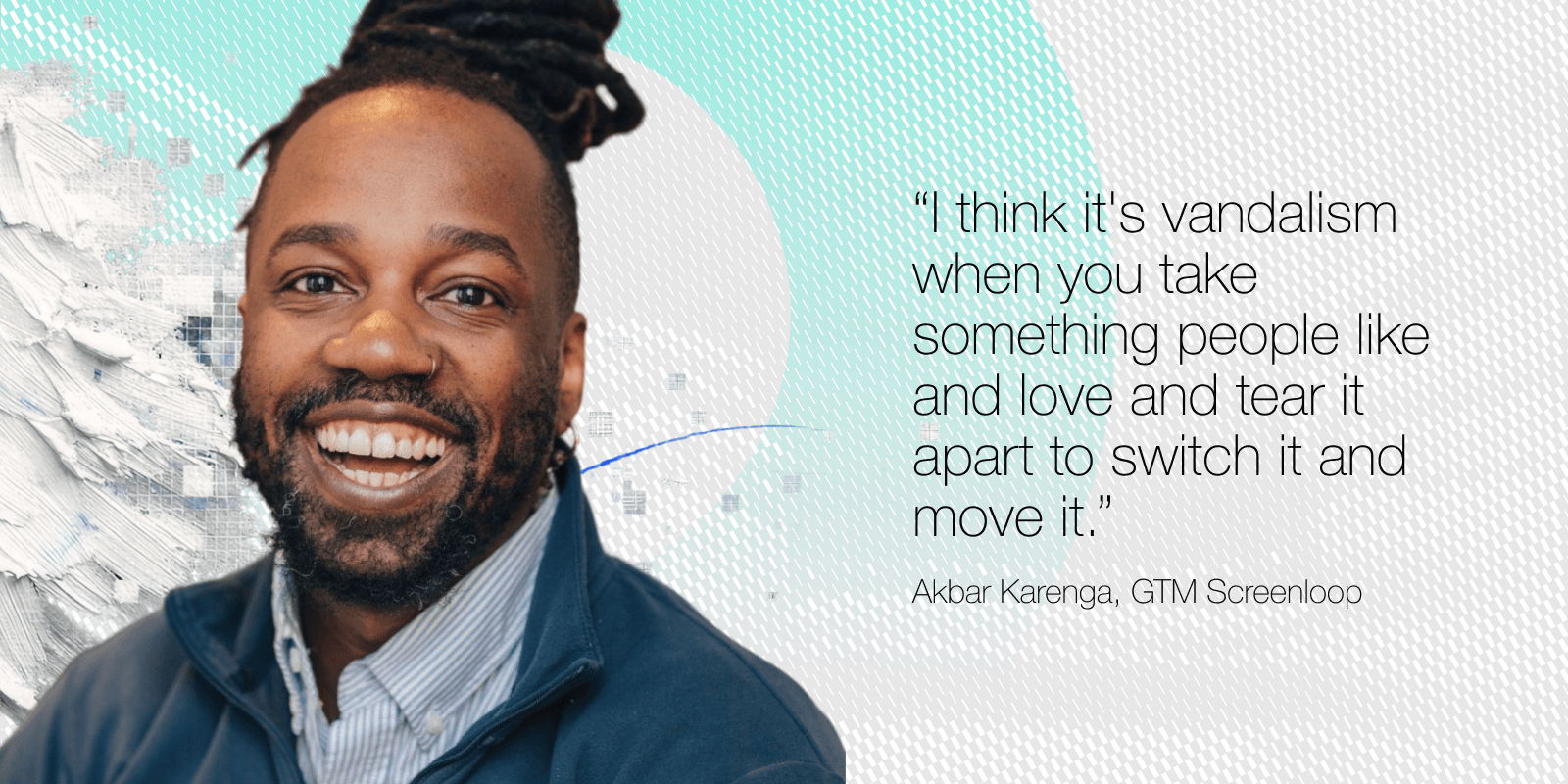
One of my favorite thinkers is Scott Galloway. He set up L2, a brand advocacy consultancy, and now does a series on startups and scaleups. He did an analysis of HBO Max: one of the most awful rebrands in history. I think it's vandalism when you take something people like and love and tear it apart to switch it and move it. HBO had a deep, intrinsic love attached to it. So we were cautious about buying something and then ripping out the very things that made it valuable in the first place.
Will the future be two separate brands? Let's see. But our initial gut feeling is that there's something already there that people like and love.
Ines Haitzinger: Love it, and love that example. From your internal perspective, what are the challenges of communicating two different brand voices?
Akbar Karenga: We made this acquisition because there were different types of customers. Equitas is about large employers and large corporates in more traditional hiring spaces, logistics, business process outsourcing, healthcare. We're very strong there. Screenloop, meanwhile, is more product-led, serving startups, scaleups, and smaller, more international businesses. So we knew there was alignment, but not overlap, between us.
That's why we decided to have separate teams and separate responsibilities, but with a counterpart on each side, for example in engineering, so we could learn from each other. I look after all of the go-to-market activities for Screenloop; Michael is the CEO of Screenloop and also the founder of Equitas. We meet to make sure each side of the business knows what the other is working on, and to find smarter things we can do together in terms of co-branding, while also recognizing there are very different ways for us to operate.
One example: some of our most successful marketing activations over the last year came from showing up as two separate brands. I wear one t-shirt, he wears the other, and we get invited into different conversations because of it.
Ines Haitzinger: Love it. You mentioned that Michael and Anton discussed the acquisition and how it made sense. Do you remember a specific turning point for Michael to acquire Screenloop? What happened that made him say, "Instead of being friendly rivals, let's join forces"?
Akbar Karenga: It was the realization that we weren't rivals. There was something new near us, next to us, but not in us. So neither of us was going to cannibalize the other's client base.
Then we looked at what Screenloop customers said and loved: very strong brand loyalty. Screenloop is famous for giving away fantastic merch, for example, and famous for great customer success. Those things are very hard to build from scratch. Even now, people email me asking, "Do you have any more Screenloop socks?" or saying, "She was absolutely amazing, she did X, Y and Z." I think that was the moment for Michael: realizing how hard that would be to build from scratch, and that it was interesting to acquire that love.
Ines Haitzinger: I always see the ducks, the sweepstakes, there's a huge, engaged community. That's what the Screenloop team built, and I imagine it's very important. You mentioned loyalty being especially important nowadays, with AI. That brings me to my next question: from your perspective, how did AI change things? Screenloop plays in interview intelligence and uses AI itself . What changes did you see with the emergence of AI, for teams in general or the sector in general?
Akbar Karenga: Imagine an X and Y axis. On one axis: what is technically feasible right now. There are things we're very sure about, even with old-school machine learning — NLP, computer vision, recommender systems. We know those work. And then there's been the slow creep toward the possibilities of generative AI.
The other axis is north-south: what is legally permissible and what is legally required. That's where you see businesses innovating and taking risks at the top of that relationship. The alignment between Equitas and Screenloop was: let's do things with AI that we know help the human right now, and leave the more theoretical claims aside.
I used to recruit a lot in the DACH region, so I'm very aware of the recruitment rules there. We've got the EU AI Act coming into effect next year, and recruitment was highlighted as a high-risk use case. We've also seen two massive class-action lawsuits in the US involving two HR-tech competitors in our space. We've always taken the more GDPR-compliant route. We want to make sure that if we sell something to a customer, it won't get them in trouble with their legal counsel.
The AI both companies use is robust, tested, and effective. To give a clear example: Screenloop doesn't overclaim or try to embellish what happens in a conversation with AI. It will remember, it will point to things, but it won't say "this person is fantastic." That's for Tamara to decide. So AI plays a part in what it's sure of, and holds back on what it shouldn't overreach on right now.
Ines Haitzinger: You said you acquired Screenloop in January, so about half a year has passed. What's your single biggest piece of advice for any marketing or go-to-market team navigating an acquisition like this?
Akbar Karenga: Be prepared to be surprised by your initial expectations. When we first onboarded and acquired the company, we had an expectation of how much business we'd retain at renewal. We were wildly amazed by how many customers (well above expectations) wanted to stay with Screenloop. There was a lot of love for the brand. Some customers had understandable reasons to reconsider. Prices change, services change, but we still retained far more of the business than expected.
How did we get there? Change management, initially. We went on a 60-day plan where, to put it bluntly, we shut up and listened. We were going to listen to customers: What do they like? What do they hate? There was no "we're going to launch this" or "here's a new tag bar." Just slow down and listen, listen, listen.
That allowed us to move to the second part, which is my other piece of advice: measure twice, cut once when it comes to new product or new brand positioning. Listening let us conclude, "Maybe we don't need to move dramatically this way, maybe we just need to do X or Y." If we'd come in with big assumptions, added a new engineering team, and built things a certain way because of what worked in the previous business, we'd have wasted time and money and maybe alienated more customers.
On the M&A process itself, what we could have done better is the tooling and services that come with you into the new company. It's always a messy handover. With your previous team, make sure there's a bit of overlap before everyone leaves or moves into new roles: Who owns the billing, who owns the admin tools for a system you didn't even know about? Take a little time there.
My third piece of advice: however important or dramatic the change feels to you, a lot of the industry and a lot of your customers may not care. They're busy with their own work. They might not have even noticed your lovely blog post about the new positioning. One thing we had to do was reintroduce ourselves: "By the way, you're coming up to renewal. Did you know we were acquired?" ... even though we'd told them two or three times. Be ready to retell the story, because what's dramatic news for your company lands on people whose day jobs are totally unrelated.
Interview conducted on 20 July 2026. Special thanks to Akbar Karenga for taking the time to share his experience and insights.