“You get to focus your design eye and your design resources on the more interesting creative work you wouldn’t want an AI to be solely responsible for.”
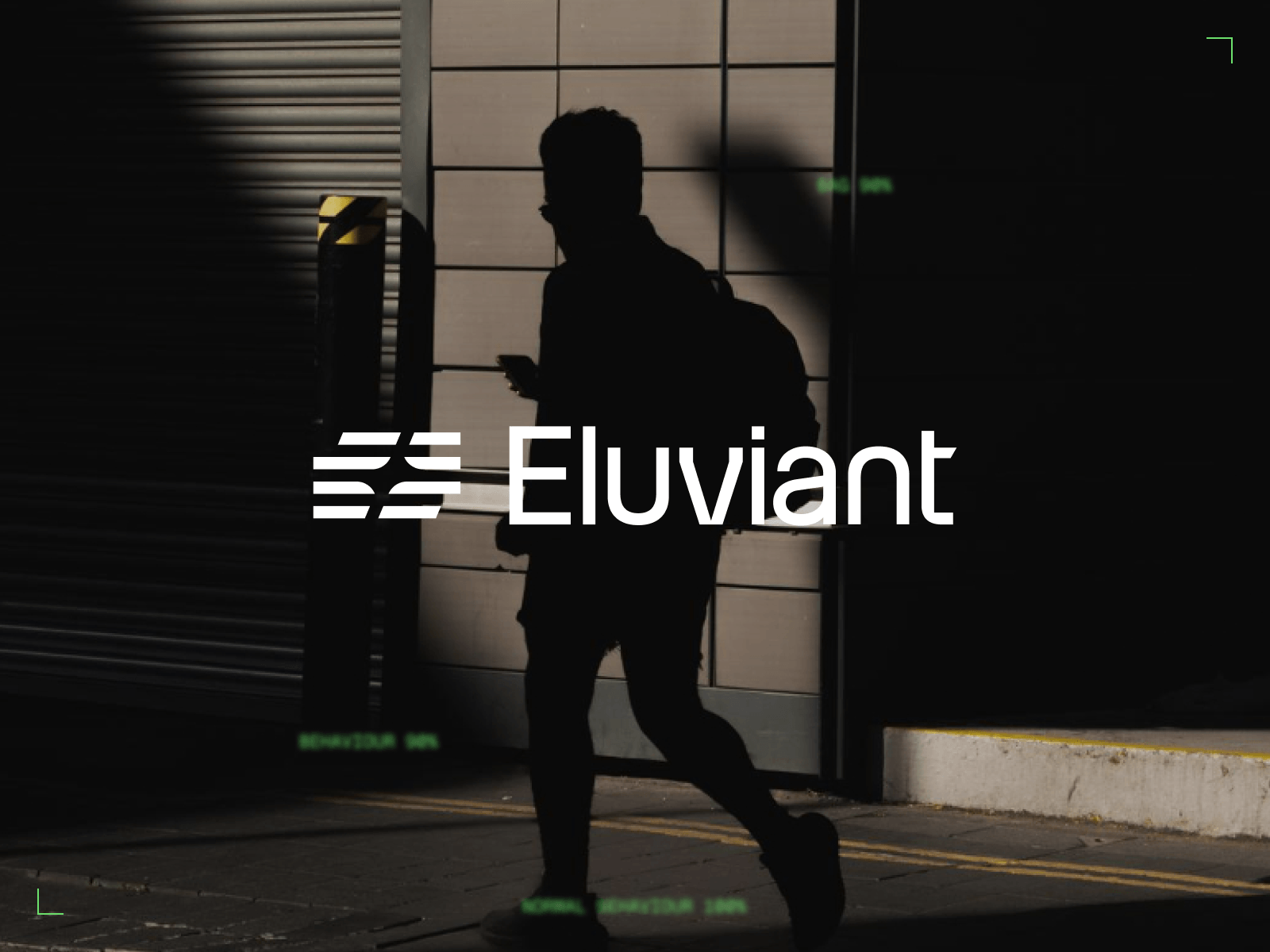
Eluviant is a London-based AI video intelligence company. It turns CCTV and other video feeds into actionable intelligence for security teams and control rooms. Its GenAI layer, Aurora Flow, reads context across sequences of frames. It can tell similar-looking events apart and recommend a response, but the decision stays with people.
In April 2026, we designed Eluviant’s visual identity for its startup rebrand, along with the brand design system behind it, built to scale with a fast-growing company.
We talked to their Head of Marketing, Aimen Chouchane, about running a full rebrand as a one-person marketing team. We also asked why AI design only works on top of a human-built brand system.

AI only works on a human-built brand system
As sole marketer responsible for Eluviant’s rebrand, Aimen was facing time and resource constraints. In six and a half months, he had to carry out naming, branding, and the web relaunch.
After the tough naming exercise led by Aimen, our designers at The Branx created the full brand design system. That system is what let him produce marketing materials himself with Claude.
“A lot of our document templates were generated with Claude Design. But that was only possible because the brand had been created by humans with human sensibilities, and then you give the AI strict guardrails.”
In the interview, Aimen explains how he ran a rebrand at sprint pace, where it nearly broke and what he’d tell other solo marketers before they start.
Complete interview transcript
Ines: Good to see you again, Aimen. We were in touch a few months ago about the rebrand from IntelexVision to Eluviant. For those who don't know, what does Eluviant do in a nutshell?
Aimen: Sure. Eluviant is a video intelligence platform powered by AI. You probably see CCTV cameras in your daily life (I see them all the time because I'm so conscious of them now) keeping property safe and helping with traffic flows. Any speed camera, for example, runs a basic version of video intelligence to recognise your licence plate.
What we do is turn a video feed into a source of actionable intelligence. The system can see and, more importantly, understand what is happening in the scene. That helps the people on the other end, the staff in control rooms and security teams, react more quickly to incidents and get a more comprehensive understanding of what's going on across their estates.
Ines: That's super impressive. I read that the company was founded in 2017 as IntelexVision. We're now in 2026, and a lot has happened since then, also in the AI world. What has changed between 2017 and today?
Aimen: Almost a decade, so a lot. But if I condense it down: generative AI going mainstream is the main thing that has changed the game.
The video analytics industry has been around for a while. At the birth of CCTV there was no technology helping you understand what was going on, not even the basics like whether there was movement on screen. That's where it started. Then layers were added: basic object classification, so you went from "something is moving" to "it's a person" or "it's a car". Then machine learning came in, with pattern recognition and behaviour recognition.
Now generative AI is fully integrated into the Eluviant platform through Aurora, our dedicated GenAI capability. It lets you not just see what is happening but understand the context. That makes the system highly configurable to very specific circumstances, so you can be very precise about what you do and don't want to be alerted on.
With the launch of Eluviant as the new face of the company, we also launched a new version called Aurora Flow. It understands not just what is in a single frame but a sequence of frames, so it can accurately distinguish between movements that look and feel very similar.
A good example of where GenAI's power comes in: are two people fighting, or are they hugging? It's a fairly simple example, but with image-based analysis alone, without context, those two sets of still images can look very similar. If you can take in wider contextual clues (how the people entered the scene, how fast they came together, whether their faces look happy or angry and aggressive, and the setting it's all happening in), GenAI can assess what's going on and make a recommendation. It never makes a decision. It makes a recommendation based on what it thinks is the most likely scenario unfolding.
Ines: When we first talked about the new name, you said it comes from shining a light. Can you tell us how you came up with it? What was the rationale behind it?
Aimen: Coming up with a good name in 2026 is incredibly challenging. From the outside you think you just pick a name you like. But we have operations and people in 15+ countries, so there are a lot of trademark issues to consider, and you want a clean domain for the website. With an international partner and customer base, you want something that, first and most importantly, won't offend anybody because it means something you couldn't have foreseen in a language no one on the team speaks. Second, it has to be pronounceable and accessible. And then you want it to convey something about the company.
So it was quite an in-depth process, and we were very rigorous about it. We worked with a good friend of mine on an initial workshop to set the boundaries for the discussion. We consulted the entire team, collected their name suggestions, considered every one, and gave our reasons for which went forward and which didn't.
Then, when we got down to it, it was a lot of back and forth with Claude. It's not a replacement for IP lawyers, but we had to move quickly, and it was a good sounding board because it could run very quick checks against the international IP databases.
I was playing around with the word "elucidate", which has a Latin root, elucidare: to bring something out of darkness, to make it clearer than it was before. We thought that was a nice concept for what we do, which is to bring a lot of video footage that either doesn't get watched or doesn't get fully understood into the light and clarity of understanding.
We were never going to get the actual word, because it's very hard to trademark words from a particular language, but that was the starting point. The little flourish came from putting "vi", for video intelligence, right in the middle of the word, which I thought was quite elegant.
It wasn't a massive flash of inspiration. It was following a rigorous process, understanding our boundaries, and working within them.
Ines: You did a full rebrand: naming, visual identity, the website rollout and, I guess, hundreds of brand and marketing collaterals. How long did the entire rebrand take?
Aimen: We went at a sprint pace, because we had some commercial imperatives. End to end it was roughly six and a half months, from a blank sheet of paper with no name ideas to formally launching the new name and brand to the world in early July.
That's quite a pace considering the amount of change. If you're just refreshing the visual identity, there's enough to do. But when you change the name of the company and the registered company name, especially across markets, there's a lot of internal plumbing you need to take care of too. So we ran several parts in semi-parallel, when ideally you'd tackle them one by one.
Ines: You led the entire rebrand. You had stakeholders behind you, and they were aligned, but you were leading it. What was your biggest learning or your biggest challenge along the way?
Aimen: Obviously the pace was the biggest challenge. You had to move quickly off things or onto things when making decisions. On the naming side, we couldn't even run multiple names through our IP lawyers. We had to give them one name, with a decent degree of certainty we'd get the trademarks for it.
Beyond that, when you have a large number of stakeholders and you're very international, the challenge is understanding what's true signal and what's noise in the feedback. People have concerns. Change is hard.
What I learned is to always lean towards overcommunication. People should be sick of hearing from you. If you undercommunicate, it becomes harder to move quickly, because people come late to the party with concerns, and sometimes those concerns are very important. Someone might know something that stops you making a decision that would cause you a lot of issues down the line and be very hard to undo in a short time frame.
Ines: You mentioned using AI for preliminary trademark checks, and on one of our calls you'd uploaded the brand book we gave you and were creating assets yourself. How much did you use AI during the rebrand? Was it only helpful, or did it sometimes create something where you thought a human would have done it better?
Aimen: I don't think we could have achieved everything we did in that time without it. We worked with you, and with a great agency on the web design side, Hydro. But the internal design team was essentially me, and the internal project management team was me. Claude helped a lot with both.
I built an entire plan with Claude, with 15+ workstreams all mapped out in a Claude-generated Gantt chart. Then Claude was my accountability buddy, holding me to the actions I had each week. It went from basic due diligence on name ideas all the way through to something that has been incredibly beneficial, and that I'll think about every time I do anything brand-related: an AI-friendly brand book, as a Figma file, that Claude Design can ingest in its entirety.
A lot of our document templates were generated with Claude Design. But that was only possible because the brand had been created by humans with human sensibilities, and then you give the AI strict guardrails. Claude Design is essentially painting by numbers when you feed it a comprehensive brand system and guidelines. If you go to our LinkedIn page, you'll see designs produced from templates that originally came from Claude Design. Most of our PowerPoints and Word documents were produced with Claude Design, with some finishing touches by me.
It was a fundamental piece of the infrastructure needed to pull off such a huge transformation of the company's identity in such a short time.
Ines: You were a single marketer pulling a lot of strings. I'd call you an AI-enhanced marketer, since you did designs and project planning yourself. What's your biggest piece of advice for other marketers running a rebrand on their own?
Aimen: First, be really clear about where you want to spend your time and where you don't, because that shapes how you use AI. Make sure you're aligned with your decision-makers internally on where AI use is acceptable and where it isn't. Otherwise you'll end up clashing. It's better to establish that up front.
Beyond that, play around. It's a wonderful playground, but it requires time to try things. So start small, build confidence, and build up from there.
I've now progressed to using a combination of Claude and Claude's coding ability to create self-serve brand design for our entire team. Our partners and our internal team can create their own social media assets without asking me or an internal designer. They get a template-based system: they enter the information that needs to change and download the result.
That evolved from starting with the same model for business cards, which are much simpler because the base design stays the same and only the text changes. Start small, get that working well, and then you know how to do it bigger and better next time.
Ines: That's super impressive, a self-serve brand toolkit that keeps you away from all those details like "fix this presentation". And you learned along the way: you started small, and now you're coding with Claude and optimising workflows. That's quite a journey.
Aimen: The experience has changed how I think. Now every time we need to create something branded, I ask whether I should build a platform to generate that asset on an ongoing basis. And you design in a different way. Your design sensibility turns towards clean, simple and easily replicable when you're not touching it directly.
I want to be clear: I'm not one of those people who says you don't need a designer anymore. I'd be interested in what you think, but I think it's actually a really good thing for the design world. You can only be so creative with a business card. You'll produce far more LinkedIn content than will ever get huge numbers of views. So you get to focus your design eye and your design resources on the more interesting creative work you wouldn't want an AI to be solely responsible for.
Ines: I share that opinion. It's important to have a solid foundation. Lower-priority things can be done by AI, while others need a human eye or a human hand.
Ines: Have you seen the buzzword "AI slop", where AI hallucinated and you thought, "This looks like just another AI startup founded two weeks ago"? Did that happen during the rebrand?
Aimen: The area I think is still lagging, though I'm sure it'll catch up, is AI video generation. I experimented with it for a couple of things and decided it wasn't what we wanted. When you prompt it for little animations, it goes very literal, and everything looks the same as what everyone else is doing.
For our industry, security, it always wants to show massive control rooms with a hundred screens and blue mood lighting, and it never seems able to get away from that. You can see why: there aren't many videos or photos of control rooms on the open internet, because they're secure environments where you often can't even have your mobile phone. So it relies on mockups and people's visualisations of what a control room looks like, and then it feeds on itself and the effect compounds.
So full AI-generated video is where I've put the brakes on. But on the whole, if you provide good raw materials, you can keep it under control.
Ines: Did you ever use the Pixel-Art Tool our team created, where the images blur and pixelate the non-essential parts of the footage?
Aimen: Yes, it's in a few places. I'm pretty sure, and I'm just looking it up while we talk, that you can see it somewhere on the front page of the website. It's also in a couple of our blog posts as lead images.
It's cool to have that ability, and it ties back to what we discussed. Lots of businesses are fortunate enough to have internal designers or the budget for a design agency on retainer. Lots aren't, or it isn't where they want to spend their money. Now you can put good design in the hands of people who aren't design-oriented, it stays consistent, and you can do more than the basics. You don't have to rely on Canva templates the way you probably did five years ago. That's a really good thing, so thank you for building that for us.
Ines: Great to hear you're actually using it. The team put time into giving you a tool that's unique to your business and your imagery. We're already at time, so I'll stop the recording here. Thank you so much for your time, Aimen. It was good to see you.