In 2026, startup branding pricing ranges from roughly $500 for a marketplace logo to $200,000+ for a full enterprise rebrand with extensive research and multi-market rollout. Where you land depends on your funding stage, the scope you actually need, who does the work, and how fast you need to launch. The most realistic cost ranges from $25,000 to $50,000 for branding that keeps up with your product.
What should startup branding include in 2026?
Branding in 2026 is a system, consisting of four layers.
Strategy and approach
Where your mission, vision, purpose, market environment, competitors, etc. come together. This translates into brand archetypes, brand values, creative concept, and storytelling.
Visual and verbal identity
The visual identity is what most people picture when they think "branding." Logo, color palette, typography, visual language, iconography. That’s the visual output. Brand messaging and tone of voice - the verbal identity - also plays a huge role here.
Scalability
Scalability is how easy your team can scale the assets without needing three expert designers. Your website, pitch deck, social presence, product UI, email templates. The faster you grow, the more important a scalable brand is.
Ongoing multi-market and multi-platform support
The first three layers are things you buy once. This one is a standing commitment, and it's the layer founders discover late. A brand that works in English for a US audience doesn't automatically work in German or Spanish, because translation moves words and adaptation moves meaning, and only one of them sounds like a founder wrote it. Platforms multiply faster than guidelines do: the same identity has to hold at 16px in a product dashboard, at 10ft on a conference stage, in an app store listing, and inside an AI-generated summary of your category that you didn't write and can't edit.
How much does a startup brand identity cost?
The maths is actually easy:
Price = scope + seniority.
Out of this simple formula, you can identify five levels we’ve split from 0 to 4. Each level adds a layer of scope and expertise. Most seed-stage startups land in level 3.
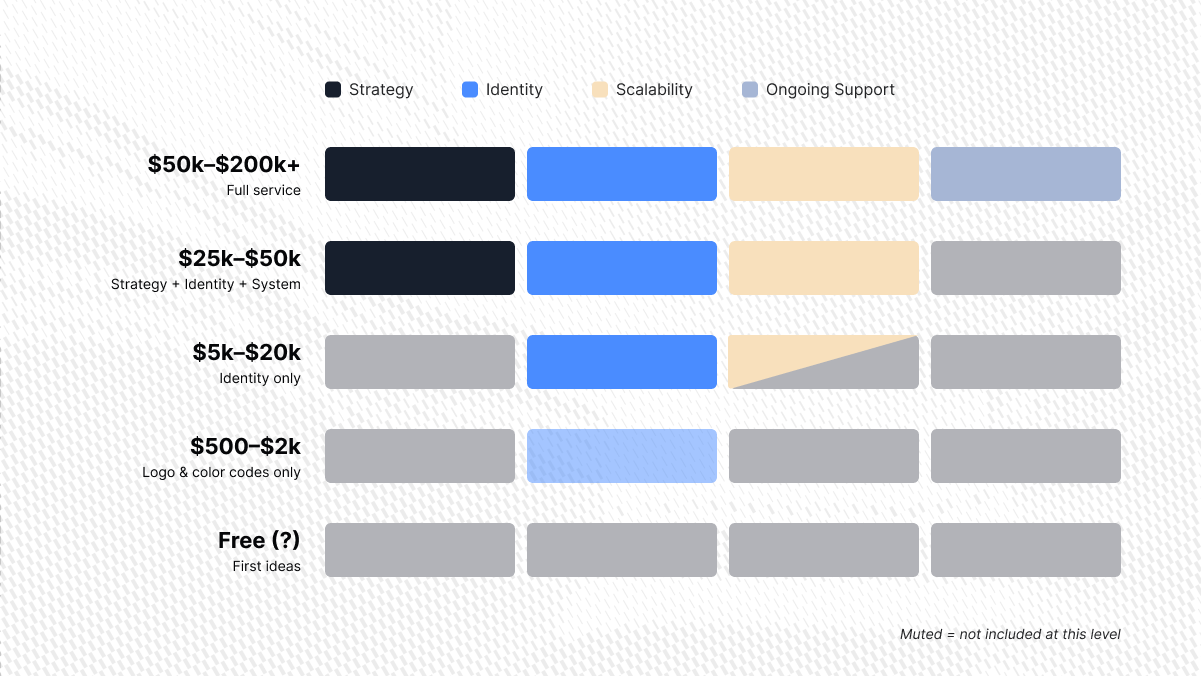
Level 0: AI. Nearly free (supposedly)
Claude, Midjourney, and similar tools are great for mood-boarding and generating a first direction, but they don't understand your specific buyer's psychology, your product architecture, or trademark viability. They mix together what has already been generated and give you a generic output. You still need a human to ground the idea, put it into context, fine-tune and bulletproof it. So you end up back at the freelancer, just with an AI-generated brief.
Pros
- Fast to explore, costs almost nothing (if you are token-conscious)
- Good for early creative exploration
- Useful for generating messaging & tone of voice drafts, naming brainstorming
Cons
- Can't do actual trademark research or competitive landscape analysis
- Outputs are statistically average, trained on everything, optimized for nothing specific
- Still requires a human designer and/or copywriter
Good for: the hobbyist, the side project, the founder who needs to put something on a deck by Friday and knows they'll redo it later.
Examples: Claude, ChatGPT, Midjourney for exploration. Looka, Brandmark, Canva Magic Studio for generated logos.
Level 1: Freelancers and marketplaces. $500 to $2,000
A step up from AI in execution, but not in strategy and brand longevity. Often it is just logos and color hex codes. You get a skilled pair of hands without the strategic brain behind them. The brief you write determines the quality of what comes back, which means the output is only as good as your own understanding of branding.
Nothing wrong with that for a pre-revenue product still finding its market. The risk isn't what you spend. It's what it costs to undo later: If there is a visible gap between the valuation you’re asking for and the brand meant to justify it, investors will notice.
And then? Straight into the rebrand. With more time and money spent on branding than it would have taken at the beginning.
Pros
- Cheap (at first)
- Fast; days, not weeks
- Puts a mark on the deck and the domain so you can get on with building
Cons
- Template work is generic by construction, chances are that there’s a company out there with a very similar identity
- No strategy, so every decision starts from nothing
- Marketplace designers don't run trademark checks, and you inherit that risk
Good for: proof of concept, pre-revenue, internal tools that never go customer-facing.
Examples: Fiverr, Upwork, 99designs, DesignCrowd.
Level 2: Experienced freelancer or small boutique. $5,000 to $20,000
Logo plus basic identity. Color palette, typography, usage rules, and usually a simple guidelines document that allows for limited scalability. This is the most common range for early-stage startups working with an experienced freelancer or a small boutique.
You get enough to brief a web developer, produce consistent social graphics, and hold your own in an investor meeting. You don't get strategy, and often the system lacks scalability or application guidance.
Pros
- Enough system to keep a website, a deck, and social output looking like one company
- An experienced freelancer at this level produces real craft, not template output
- Three to five weeks in most cases
- You own working source files rather than flattened exports
Cons
- No positioning and strategy work, so the identity could work for everyone in your sector
- Guidance stops at handoff, application and brand consistency is up to you
- Rarely survives a pivot or a category shift
Good for: seed stage, early go-to-market, pre-launch with a clear market position.
Examples: Halo Lab, Duck Design. Plus individual senior freelancers.
Level 3: Startup branding agencies. $25,000 to $50,000
This is where strategy, execution, and service come together. Full brand system, often including web design and development. Strategy, identity, and a set of applications covering website, pitch deck, and core marketing materials. This is the range where you're buying senior creative direction rather than execution. The thinking is included, the files work, and the system is scalable. Four to six weeks of focused work from a small, experienced startup branding agency team.
Pros
- Discovery phase, so the designers know your market and your competitors before starting the creative work
- Strategy and identity get built together, so the visual choices have reasons behind them
- Senio creative direction rather than execution against a brief you had to write yourself
- Everything is designed as a system, able to scale across product, web, sales, and marketing
- Brand guidelines your startup team can actually use to grow your brand
Cons
- Four to six weeks, with founder input required throughout (workshops, reviews, feedback loops)
- Not the right move if you're still figuring out your ICP or pivoting every quarter
- Overkill before product-market fit
Good for: the tech founder raising or just post-raise, seed to series A, who's starting to spend on acquisition and needs the brand to do conversion work.
Examples: The Branx, Focus Lab, Ramotion, Crafted, La Visual.
Level 4: $50,000 to $200,000+
Exceptional work from a full-service agency. Research, strategy, identity, applications, and launch. You're buying a team, a process, and often a name on the work. The process is built for clients with procurement departments, legal review cycles, and six-figure retainers. At this tier, you're also paying for the agency's reputation as much as their output.
Pros
- Research depth that surfaces what buyers actually believe about your category
- Genuinely great creative and strategic talent
- Multi-market and multi-language rollout handled properly
- The agency name on the work carries weight with boards and enterprise buyers
Cons
- Timelines run four to six months, sometimes longer
- Account management and overhead are a real share of what you pay
- Layers of approval slow every decision
- Overkill for anything below Series C or D
Good for: established revenue, enterprise sales, IPO preparation, major brand pivots.
Examples: Motto, Pentagram, Wolff Olins, Interbrand, COLLINS, Koto, Siegel+Gale, Red Antler, Big Human.
Can my product design team do branding?
This is quite a common move:
"We have a product designer, just have them handle the brand."
But here’s the math: A senior product designer at a 70k base salary costs about 90k a year (incl. Tax, insurance, software, etc.), This means $7,500 a month. Because they're a UX/UI specialist, (not a brand expert), it'll take at least 3 months to get somewhere solid, plus constant internal alignment across you, marketing, and sales.
That's $22,500 in salary cost alone, except you've also frozen your product roadmap for a quarter.
Pros
- Feels like an internal, zero-cash-outlay project on day one
- Knows the company/market very well (quick onboarding)
Cons
- Costs almost the same as a premium agency
- Paralyzes your core product roadmap for a quarter
- A lot of pressure on a single person
- Expert in product design but maybe lacking a strategic approach
- Might result in a brand optimized for an app interface rather than market positioning/awareness
Good for: Companies with no launch urgency and highly mature, multi-disciplinary in-house creative departments
What influences the cost of startup branding?
In short: 6 variables influence how much you’ll pay for your startup’s visual identity. Most of them are within your control.
Scope
The largest cost driver by a wide margin. A logo is not the same as a full visual system. Be specific about what you're buying before you agree to a price.
Who does the work
An experienced branding agency with a dedicated team costs more upfront than a solo freelancer. For branding for AI and SaaS startups, sector expertise and experience in understanding and branding tech solutions are crucial to get the direction right and reduce feedback rounds.
Research and strategy depth
Competitor analysis and messaging architecture add time and cost. Skipping them often means starting over when the brand doesn't land with buyers or investors.
Timeline
Standard delivery with structured revision rounds costs less than a compressed sprint. Agencies that deliver in weeks rather than months, as The Branx does, get there through process discipline rather than by cutting corners. When speed matters, budget for it explicitly.
Geography and production complexity
Multi-region rollouts, translation, and region-specific creative variations add budget that founders rarely anticipate.
Industry specialization
AI and B2B SaaS carry category conventions, buyer expectations around credibility, and technical complexity a generalist designer won't handle well. That specialization costs more and usually pays for itself in fewer revisions.
Hidden branding costs founders consistently underestimate
The small line items add up faster than expected to the price.
Trademark filing
The USPTO base application fee is $350 per class when you use a pre-approved description from the Trademark ID Manual. Write your own description and it's $550 per class. A two-class filing with custom descriptions is $1,100 in government fees before a lawyer touches it. Add attorney fees for a proper clearance search and budget $1,500 to $3,500 for a straightforward single-market filing.
Asset production
Custom photography, 3D renders, illustration sets, and art direction sit outside most branding quotes and are required for a website launch. Add $3,000 to $15,000 depending on volume.
Rollout and accessibility
Applying the brand across existing touchpoints, checking contrast ratios, updating decks, and briefing the team takes time someone has to spend. Put it in the timeline, and in the scope if your agency offers it.
Tools
Choose wisely when picking the right plan for Figma, Jitter, Claude, and other tools. Small costs sum up quickly to what, at the end of the year, turns out to be a fortune.
Where startups overspend in branding, and where cheap is fine
Overspending is as real a risk as underspending.
Common overspend patterns:
- Paying $10,000+ for a logo with no strategy attached
- Creating motion graphics before product-market fit
- Building dozens of marketing templates before you know which channels convert
- Hiring a generalist agency at enterprise rates when a category specialist delivers better work for less
Cheap is often fine for:
- Domain and basic hosting at pre-seed
- A lightweight visual identity to reach your first 10 customers while you validate the problem
- A Figma brand kit from a skilled freelancer when you're pre-revenue and not yet in investor meetings
The moment you engage enterprise buyers, run paid acquisition, or prepare a raise, cheap branding becomes expensive.
The cheapest quote is rarely the cheapest project.
It erodes trust exactly when trust is the product.
Before commissioning a branding project, what should I consider?
A well-structured SOW prevents the four disputes that account for most bad branding engagements: scope creep, revision disagreements, missing deliverables, and unclear IP ownership.
Scope
- Exact list of deliverables with descriptions, not category names
- Number of revision rounds per deliverable, and what happens after they're used
- What's out of scope and requires a change order
Timeline
- Start date, milestone dates, final delivery date
- Your input windows, meaning when you owe feedback
- What happens if either side misses a milestone
Rights and usage
- Who owns the IP on final payment (you should own all final files outright)
- Which file formats come in the handoff (source files, not only exports)
- Whether third-party assets such as fonts or stock carry ongoing costs
What are green and red flags when hiring a startup branding agency?
Red flags
- "Unlimited revisions" with no timeline attached. It means nothing and it ends in a dispute.
- Vague deliverable descriptions like "branding package" with no itemization
- No change-control clause. Any scope change should require a written amendment.
- Unclear or shared IP ownership, especially on naming and verbal identity
- No milestone payment structure. Paying 100% upfront leaves you without recourse.
Green flags
The inverse of each red flag is worth naming, because these are the things you can ask for in writing before any money moves.
- A named number of revision rounds per deliverable, with a stated process and price for anything beyond them
- Itemized deliverables, down to file formats and what "brand guidelines" actually contains at their studio
- A written change-control clause, so scope changes are a decision rather than an argument
- Full IP transfer to you on final payment
- Milestone payments tied to delivery, so both sides carry risk
Three more that separate a good branding partner from a competent vendor.
They ask about the business before they talk about design. A partner who wants to know your business setting, your value proposition, and your goals is doing strategy. One who opens with moodboards is selling decoration.
A system, not a PDF. Ask what your team can do the week after handoff. A brand book is a document someone has to read. A brand system is something a designer, a developer, and increasingly an AI tool can build with directly.
They tell you what you don't need. An agency that talks you out of naming at pre-seed, or out of motion design before product-market fit, is optimizing for your outcome rather than their invoice. It's the strongest signal on this list, and the rarest.
Ask any agency you're evaluating to answer this checklist in writing. The ones that can't will tell you something useful by not answering.
The2026 startup branding agency guide covers how to evaluate partners by stage, category fit, and process.
And in this article we've listed the best startup branding agencies of 2026.
FAQs about startup branding pricing
What should a seed-stage startup expect to spend on branding?
$25,000 to $40,000 for a brand system covering strategy, visual identity, verbal identity basics, guidelines, and basic web design and development. Examples for brandings at this level are: Eluviant (Video Intelligence), Dablam (AEO), and Featherless ( AI DevTools).
Can we start with just a logo and expand later?
Yes, and at pre-seed it's a reasonable call if you're resource-constrained and not yet in investor meetings. The risk is that a logo built without strategy rarely survives the first rebrand, and you rebuild at full cost 18 months later.
What do you actually risk with a freelancer instead of an agency?
Not the quality of individual executions. Coherence. Freelancers produce files. Experienced branding agencies produce systems. For a company preparing to raise or scale, a fragmented set of assets creates a credibility gap at the worst possible moment.
How many revision rounds is normal?
Two to three structured rounds per deliverable. More than three usually signals a brief problem rather than a design problem. If you're on round five, something went wrong upstream in strategy or briefing.
Do we need brand guidelines before launching our website?
Yes. The website gets built on top of the brand system, not alongside it. Launching without guidelines means designers and developers make brand decisions with no rules to work from, and those decisions accumulate into something expensive to untangle. If the timeline forces parallel tracks, lock the logo, color system, and type before development starts.
What's the sweet spot for startup branding pricing?
For most software and AI startups in 2026, $25,000 to $40,000 buys the best balance of cost and value. Below that band you're paying for execution with no thinking attached. Above it you're buying depth most pre-Series A companies don't need yet.
At that level you can usually expect:
- Brand strategy and positioning
- Basic messaging framework
- Logo and visual identity
- Color and typography system
- Brand guidelines
- Social media templates
- Pitch deck styling
- Basic website and UI direction