The longer you work on a product, the harder it becomes to explain.
You know every feature, every edge case and every reason it beats the alternatives. Your buyer knows none of that. They land on your homepage, scan the first screen and decide in seconds whether you’re worth their time. According to Nielsen Norman Group, the first 10 seconds of a page visit decide whether someone stays, and you need to communicate your value proposition within those 10 seconds to earn more of their attention.¹
Most early-stage startups don’t have a traffic problem or a product problem. They have a translation problem: the message makes sense to the team that built the product, not to the market that’s supposed to buy it.
This guide explains why that happens, how to spot it, and how to measure it with our free Message-Market Fit Score.
Why is it so hard to explain your own startup?
The curse of knowledge
In 1990, Stanford PhD student Elizabeth Newton ran a simple experiment. One group tapped out the rhythm of well-known songs such as “Happy Birthday” on a table. A second group had to guess the song. The tappers predicted listeners would get it right about half the time. In reality, listeners guessed correctly just 2.5% of the time.²
The tappers could hear the melody in their heads. The listeners heard knocking.
Your homepage works the same way. When you read “the AI-native operating layer for modern teams”, you hear the whole product: the demo, the roadmap, the customer call from last Tuesday. A first-time visitor hears knocking. A headline that makes sense to the twelve people who built the product tells you nothing about whether it makes sense to the two hundred who might buy it, or to the investor you need for your next round.
Your product changed, but your message didn’t keep up
Early-stage startups rarely stand still. You pivot to a new segment, add a second use case, ship the features your biggest customer asked for, and bolt AI onto the roadmap. Every change makes sense on its own. Together, they turn your homepage into a list of everything you’ve ever built.
Positioning expert April Dunford argues in Obviously Awesome that positioning isn’t set once at launch. It has to be revisited as the product and the market change.³ Most startups skip that step. The result is a page that tries to speak to everyone, so it speaks to no one in particular.
There’s a commercial cost too. In a 2025 Gartner survey, 69% of B2B buyers reported inconsistencies between a supplier’s website and what its sellers told them.⁴ When your sales calls describe one company and your website describes an older one, buyers stop trusting both.
Your website now does most of the selling
This would matter less if buyers still learned about you on a call. They don’t.
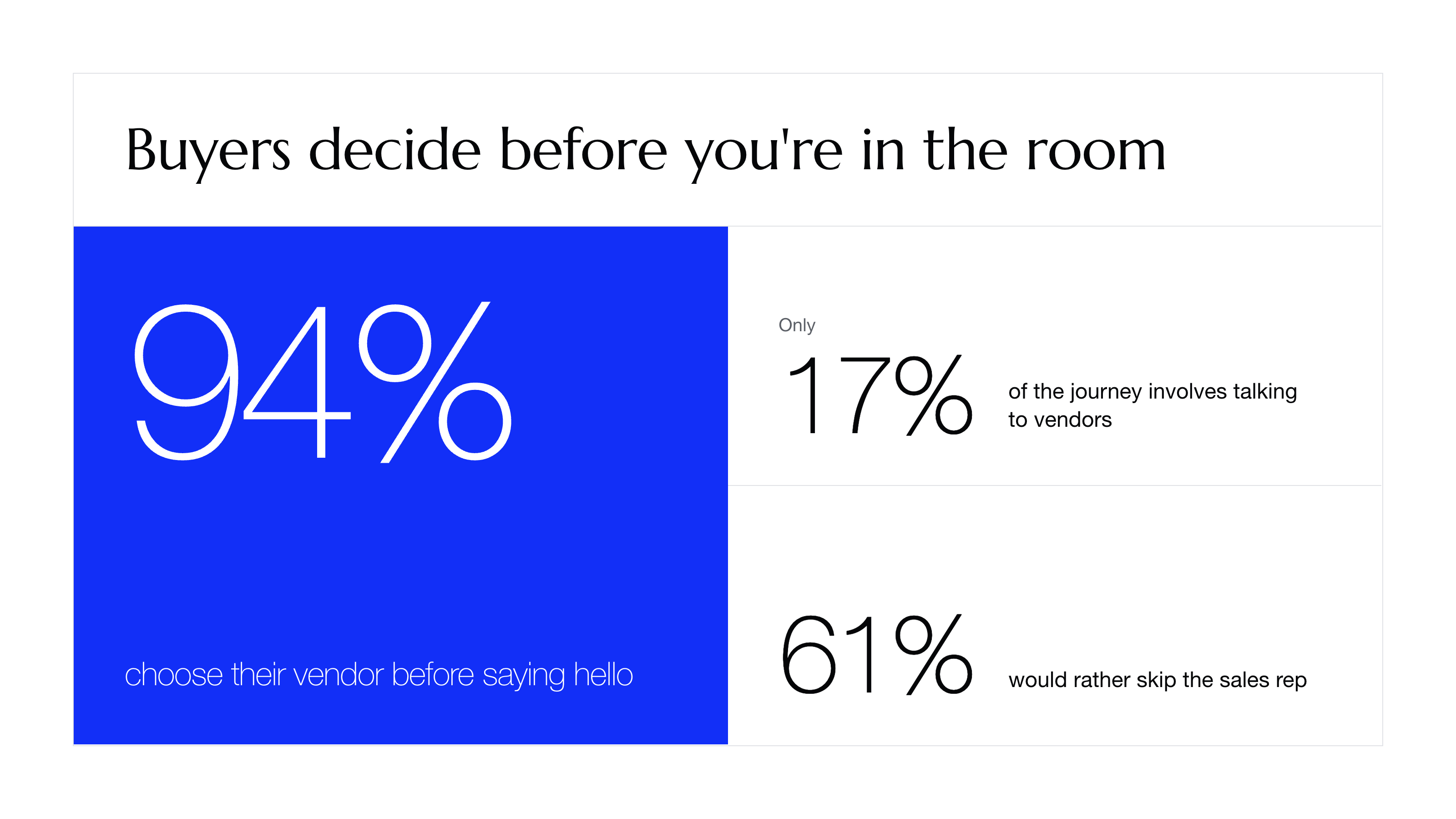
- B2B buyers spend only 17% of their buying time meeting potential suppliers. The rest goes on independent research and talking to peers.⁵
- 61% of B2B buyers now prefer a buying experience with no sales rep at all.⁴
- 94% of buying groups have ranked a preferred vendor before first contact, and that favourite wins 80% of deals.⁶
In other words, the shortlist is decided before you speak to anyone, mostly on the strength of what’s written on your site. If your message only lands once a founder explains it on a call, most buyers will never get to that call.
What is message-market fit?
Product-market fit means you’ve built something a market wants. Message-market fit means the market can tell.
Peep Laja, founder of the message-testing platform Wynter, describes it as the point where your messaging convinces your target audience that your product is the best choice.⁷ His first test is the simplest: does your audience get it when they read your messaging?
You can have strong product-market fit and weak message-market fit. That’s common in startups that grow through founder-led sales: customers love the product, but only after someone has explained it to them in person.
Simple beats clever
Founders often believe a sophisticated product needs sophisticated language. The data says the opposite. Unbounce’s 2024 Conversion Benchmark Report found that landing page copy written at a fifth- to seventh-grade reading level converts at nearly twice the rate of copy written for a professional reading level. The report also found that complex copy now hurts conversion 62% more than it did in 2020.⁸
Plain doesn’t mean dumbed down. It means the buyer doesn’t have to translate anything.
Here’s a hero line we see in some form on almost every second startup website we review:
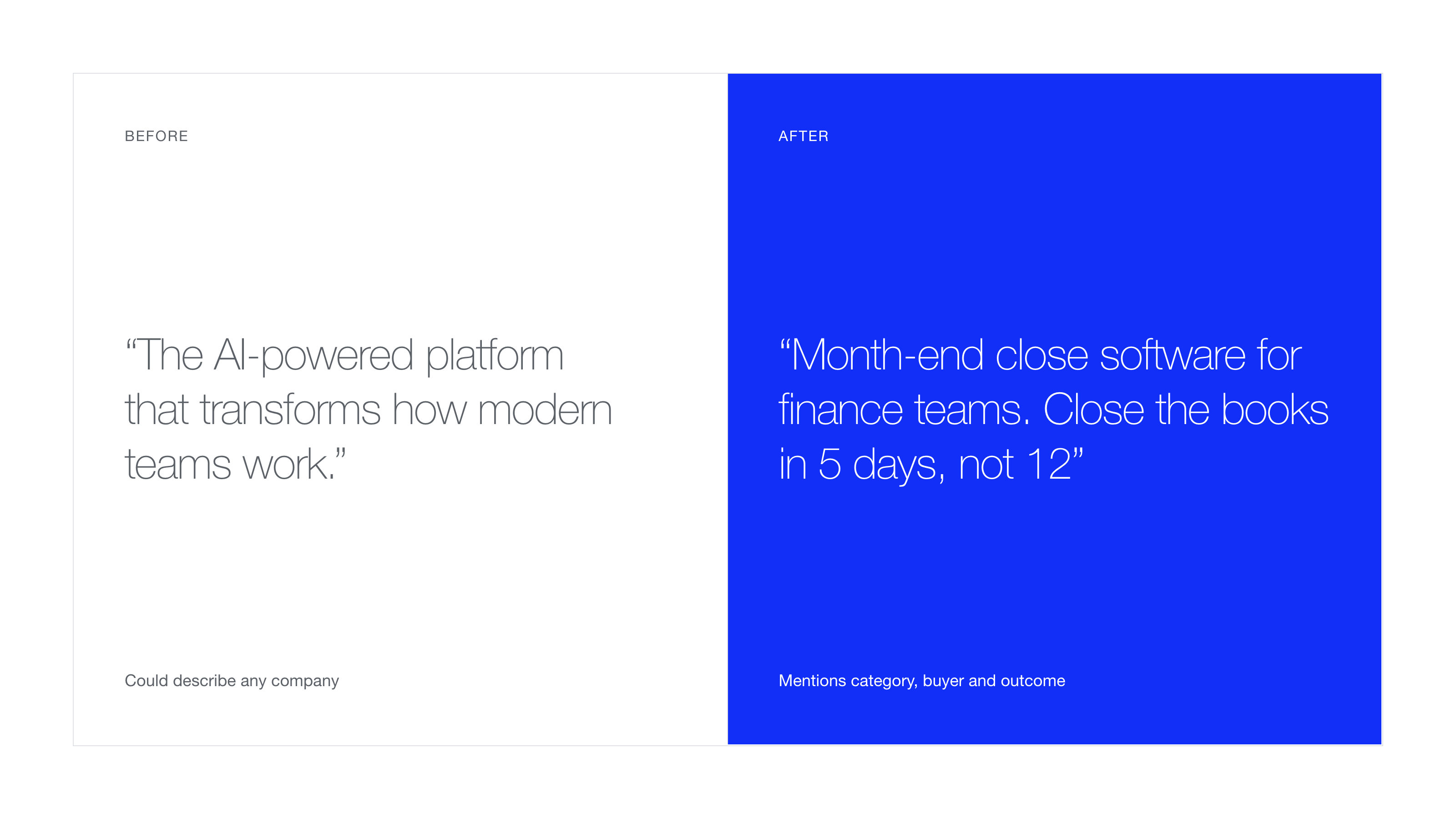
Before: The AI-powered platform that transforms how modern teams work.
“AI-powered”, “platform”, “transforms” and “modern teams” could describe ten thousand startups. There’s no buyer, no category and no outcome. It reads like a category leader’s headline, without the brand awareness that makes those work.
After: Month-end close software for finance teams. Close the books in 5 days, not 12.
It names the category and the buyer, and it gives a measurable outcome. The numbers are facts only the company can provide, and that’s exactly what our Message-Market Fit Score asks for.
How to test your message in five seconds
The five-second test is a classic UX research method that measures first impressions and whether a page’s core message comes across.⁹ You don’t need a research budget to run one:
- Show the first screen of your homepage to five people outside your company for five seconds.
- Hide it.
- Ask two questions: What does this company sell? and Who is it for?
If at least four of the five can answer both, your above-the-fold works. If the answers are vague, wrong or different from one another, the problem is your message, not your traffic. Spending more on ads only sends more people to a page they won’t understand.
Most founders skip this test because it’s uncomfortable. That’s exactly why it’s useful.
The nine building blocks of message-market fit
The five-second test tells you whether your message works. To find out why it doesn’t, look at the building blocks underneath it. We group them into four questions.
1. Who are you talking to?
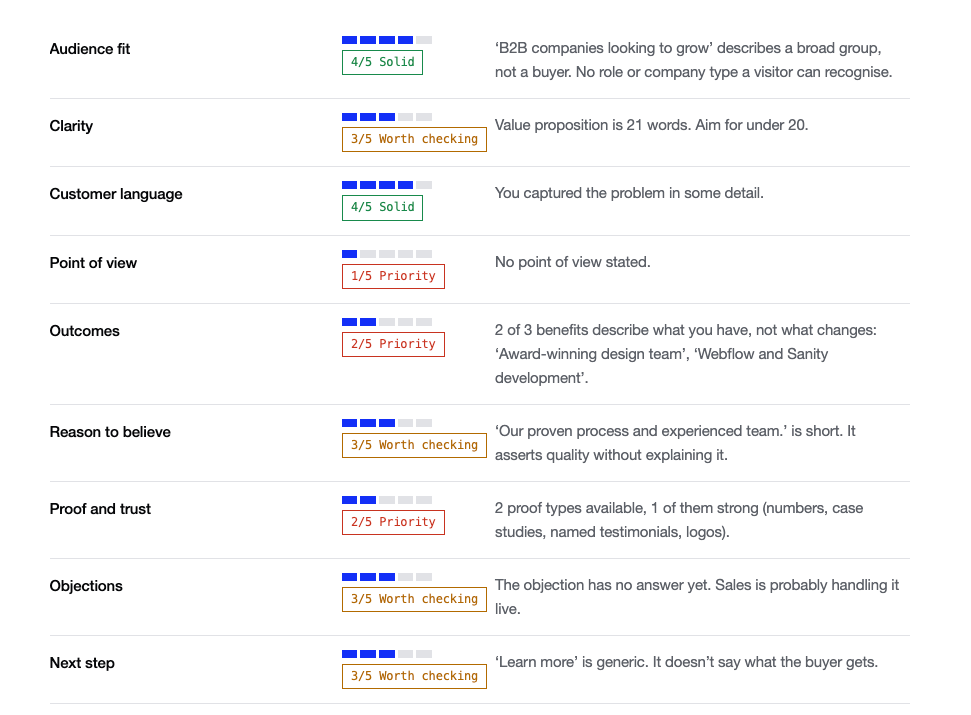
- Audience fit. Name a specific buyer: their role, type of company and size. “B2B companies looking to grow” is not a buyer. “Heads of operations at logistics firms with 50–500 staff” is.
- Customer language. Use the words buyers use about their problem in sales calls, reviews and support tickets, not the words your team uses internally. Buyers trust language that sounds like their own problem.
Two questions sharpen both: what happens in their world when they start looking, and what do they do today instead of buying from you? (A spreadsheet, an agency, an in-house hire or nothing at all are all real competitors.)
2. What do you promise them?
- Clarity. State the plain category a buyer would use, so they know which box to put you in. A stranger should understand what you sell, and to whom, in five seconds.
- Outcomes. Lead with what changes for the buyer before explaining how the product works. Buyers pay for the change, not the mechanics.
- Point of view. Take a position some buyers would disagree with. Without a belief of your own, buyers compare you on features and price.
3. Why should they believe you?
- Reason to believe. Explain why your approach works: the method, data, team or design choice behind the result. A promise without a “because” reads as a claim.
- Proof and trust. Put a number, a client name or a source right next to every big claim. Proof three scrolls away from the claim it supports does little work.
- Objections. Answer the doubts that stall deals (price, switching cost, risk, internal buy-in) on the page, before sales has to.
4. What should they do next?
- Next step. Give each key page one primary call to action, and make it say what the buyer gets: “Get my site review” beats “Learn more”. Add one line under the button saying what happens next.
Score your message-market fit
We built the free Message-Market Fit Score so you can check all nine building blocks in one go, without hiring a researcher.
It works in two parts. First, you describe your market and your message: who buys from you, what triggers their search, how they describe the problem, what you promise, and what proof you have. Then you rate how your homepage reads today.
You get back:
- A score out of 45, with a band from Not landing yet to Strong fit
- Your blind spots: areas where you rated your site 4 or 5, but your own answers suggest a 1 or 2
- Your three biggest priorities, with concrete next steps built from your answers
- A sharper version of your message, rewritten to fix your gaps
- A 30-day plan to go from score to shipped page
The blind spots are the part founders find most useful. They’re the curse of knowledge in numbers: the gap between how clear your message feels to you and how clear it actually is.
Take the Message-Market Fit Score →
Sources
- Nielsen, J. (2011). How Long Do Users Stay on Web Pages? Nielsen Norman Group. https://www.nngroup.com/articles/how-long-do-users-stay-on-web-pages/
- Newton, E. L. (1990). Overconfidence in the Communication of Intent: Heard and Unheard Melodies. Doctoral dissertation, Stanford University. Summary: https://concepts.dsebastien.net/concept/tappers-and-listeners/
- Dunford, A. (2019). Obviously Awesome: How to Nail Product Positioning So Customers Get It, Buy It, Love It. Ambient Press.
- Gartner (2025). Gartner Sales Survey Finds 61% of B2B Buyers Prefer a Rep-Free Buying Experience. https://www.gartner.com/en/newsroom/press-releases/2025-06-25-gartner-sales-survey-finds-61-percent-of-b2b-buyers-prefer-a-rep-free-buying-experience
- Gartner. B2B Sales Reps: Maximize Customer Interactions. Smarter with Gartner. https://www.gartner.com/smarterwithgartner/b2b-sales-reps-maximize-customer-interactions
- 6sense (2025). 2025 B2B Buyer Experience Report. Via Business Wire. https://www.businesswire.com/news/home/20251112018032/en
- Laja, P. Achieving Message-Market Fit. Interview, EarlyNode. https://earlynode-wordpress.vercel.app/newsletters/achieving-message-market-fit-with-peep-laja-founder-wynter
- Unbounce (2024). Conversion Benchmark Report. Via MediaPost. https://www.mediapost.com/publications/article/399080/conversion-touchstone-marketers-are-urged-to-simp
- Userlytics. Five-Second Test. https://www.userlytics.com/resources/glossary/five-second-test/